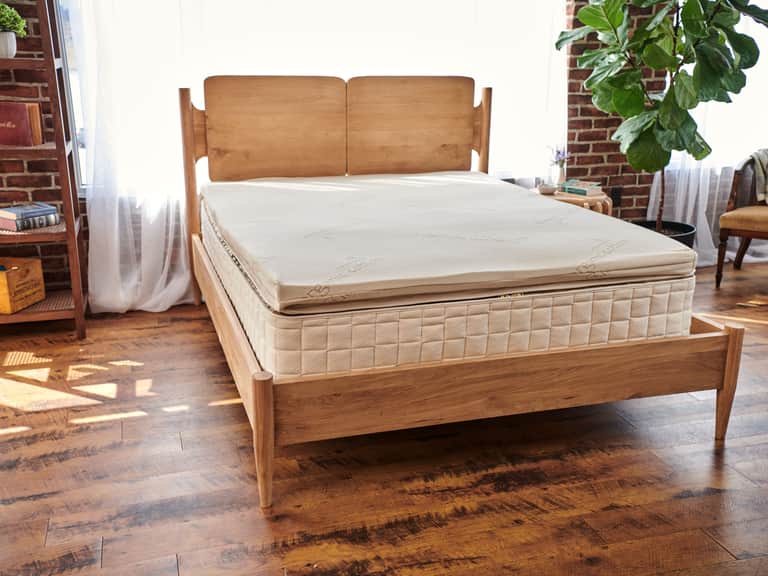
The art of sleep · Natural materials
How Natural Fillings Shape the Feel of a Vispring Mattress Topper
A topper is a subtle intervention with a surprisingly personal result. Wool, silk and resilient natural fibres each bring their own character to the bed—shaping softness, airflow and the way a surface responds when you settle in.
There is a particular pleasure in making a bed feel more like your own without replacing the mattress beneath it. A topper offers that possibility: a considered layer between mattress and sheets, intended to refine the surface rather than rebuild the bed from the ground up. In natural-fibre designs, the materials are not merely a detail on a specification sheet. Their texture, resilience and ability to manage warmth help define the whole experience.
Vispring mattress toppers draw on materials such as British wool, and some designs also include silk. In the wider tradition of natural bedding, horsetail fibre is valued for its spring and airflow. Each filling behaves differently. Wool brings gentle cushioning and moisture management; silk lends a fine, smooth softness; resilient fibres can contribute structure and a more buoyant feel. The result depends on the combination, the construction and the finished height—not on a single material considered in isolation.
That distinction matters when searching for a horse hair mattress topper or a horsehair mattress topper. The phrases are often used informally, but a product described as containing horsetail is not necessarily filled with literal horsehair in the everyday sense. Check the maker’s material description and construction details rather than relying on a broad search term. What matters to the sleeper is how the specific filling works within the topper, and how it feels on the mattress already in the room.
A topper is a finishing layer, not a new mattress
The most useful way to think about a topper is as an adjustment to the sleep surface. It may add softness, soften the first impression of a firm mattress, or offer a more cushioned feel at the shoulders and hips. It cannot, however, correct every limitation of the mattress underneath. A topper will not reliably repair a sagging core, restore worn-out support or turn an unsuitable mattress into a perfect match for every sleeper.
The mattress remains the foundation. Its support system and condition continue to influence spinal alignment and the way body weight is carried through the night. A topper changes what you feel at the surface, but it does not replace that foundation. Keeping this in mind sets a more realistic expectation: the goal is a more comfortable interface with the mattress, not a complete transformation of its underlying support.
This is one reason to begin with a precise question. Is the bed too firm at the surface? Does it feel warm or clammy? Would a little more softness help, or is the mattress already comfortably plush? These answers can guide a search more effectively than looking for the thickest topper or the most elaborate filling blend.
Wool: softness with an airy sensibility
Wool has a quiet versatility. Its natural crimp gives the fibre a little loft, while its structure can provide a cushioned, yielding contact against the body. In a mattress topper, that can make the surface feel more welcoming without necessarily creating the enveloping sensation associated with some dense foams. The impression is often one of softness with a degree of lightness.
Wool is also known for managing moisture. It can take up water vapour from the surrounding environment and release it gradually, helping the bed feel less clammy. This is not a promise of perfect temperature control: bedroom conditions, bedding layers, personal warmth and the mattress itself all play a part. Still, the fibre’s breathable character can be appealing to sleepers who want cushioning without a heavy, sealed-in feel.
In the Vispring Heaven Mattress Topper, British fleece wool and soft-needled British wool create a dedicated natural-fibre layer. The listed finished height is two inches. That relatively restrained profile may suit someone seeking a more cushioned surface without adding a dramatic amount of loft. Its wool filling is described as helping regulate body temperature and relieve pressure points; individual results will depend on the sleeper, the mattress and the bedding arrangement.
Wool’s appeal is not limited to feel. It is a material with a long history in bedding, valued for its softness and adaptability. Yet the word “natural” should not be mistaken for a guarantee that a topper will suit everyone. People with sensitivities should review the full materials and care information, and those who prefer a very firm, close-fitting surface may find even a modest layer changes the feel more than they want.
Horsetail and the appeal of resilience
Horsetail fibre brings a different idea to natural bedding: resilience. In products where it is used, its structure is intended to contribute spring, spacing and airflow within the upholstery. Rather than behaving like a uniformly soft batting, it can lend a more lifted, responsive quality to a layered construction. How pronounced that quality feels depends on the blend, the amount used and the materials surrounding it.
The phrase “horse hair topper” is therefore not enough to identify the sensation a shopper should expect. The term may refer to horsehair in a traditional upholstery context, or it may be used loosely when someone is searching for horsehair-like materials and natural fillings. Horsetail is a material name that appears in some bedding descriptions, but it should not be assumed to be present in every topper from a maker, or in every model within a collection.
When a product’s specifications identify a particular fibre, read the details carefully: Is it a principal filling, one element in a blend, or part of a deeper mattress construction rather than the topper itself? That distinction affects both expectations and comparisons. A material used in a mattress upholstery layer cannot automatically be attributed to a separately sold topper.
Resilience may be especially attractive to sleepers who dislike a surface that feels overly compressed or slow to respond. Yet it does not translate into a universally firm result. A topper’s overall feel emerges from its construction as a whole: the filling blend, quilting, cover, thickness and the mattress beneath it. If a specific fibre is important to your decision, confirm its presence in the exact model you are considering.
Silk, and the finer side of cushioning
Silk brings another kind of softness. Fine and smooth to the touch, it can contribute a refined, gentle surface when combined with other fillings. It is less about a pronounced bounce than about a supple finish and a sense of delicacy within the overall construction. As with wool, its effect depends on how it is layered and how much of the finished topper is made up of each material.
The Vispring Opulence Mattress Topper combines British fleece wool, soft-needled British wool and silk. Its listed height is 3.1 inches, giving it a deeper profile than the Heaven model. The product details describe wool as helping regulate body temperature and silk as contributing softness and cushioning. Eight straps are specified to help hold the topper in position.
That additional height can create a more pronounced change in the bed’s surface, but thickness alone does not tell the whole story. A lofty topper may feel plush, yet its true effect also depends on the mattress’s firmness, the sleeper’s weight and preferred position, and how the fillings settle under use. Consider the Opulence as a particular blend and construction, not simply as a thicker version of another topper.
Height changes the first impression
Finished height is one of the easiest details to compare and one of the easiest to misread. A two-inch topper and a topper just over three inches may differ in how much cushioning they add, how much the bed’s profile rises and whether the fitted sheet still accommodates the combined depth. But height does not equal softness in a simple, predictable way. A lower topper can feel very plush; a deeper one can feel more structured than expected.
Before choosing, measure the mattress and consider the depth of the fitted sheets. A new layer can make a close-fitting sheet difficult to secure, and a topper that shifts can disrupt the smooth, composed feel you wanted to create. Retention details matter: straps, the topper’s dimensions and the way the sheet fits over the full bedding stack all influence day-to-day practicality.
The surface should also remain compatible with the sleeper’s position. Side sleepers often appreciate cushioning at the shoulder and hip, while back and stomach sleepers may be more sensitive to a surface that lets the body settle too deeply. These are tendencies, not rules. Body shape, mattress firmness and personal comfort preferences are equally important.
Choosing a topper for the mattress you own
A thoughtful choice starts with the mattress, not the product page. Note its age, condition and current feel. If it is even and supportive but slightly too firm, a natural topper may be a practical way to add softness. If it has a visible hollow, uneven edge or persistent lack of support, adding a topper may disguise the discomfort briefly without addressing its cause.
Next, describe the desired change in everyday language. “A little softer at the surface” is more actionable than “more luxurious.” “Less clammy by morning” points toward investigating breathability and bedding layers. “More cushioning at my shoulder” helps focus attention on the interaction between sleep position and surface comfort. The more clearly you can name the issue, the easier it is to decide whether a topper is the right response.
- Consider the mattress first. A topper is best suited to refining a mattress that remains supportive and in good condition.
- Compare the filling blend. Wool, silk and resilient fibres have different characteristics; verify the materials in the exact model rather than assuming they are interchangeable.
- Read the finished height. Allow for the full mattress-and-topper depth, including fitted-sheet compatibility.
- Think about your sleep position. The cushioning that feels soothing at the shoulder may feel excessive to someone who prefers a flatter surface.
- Check care guidance. Natural fillings can require careful spot cleaning and protection from excess moisture.
- Look at the practical details. Dimensions, securing straps and warranty terms are part of everyday use, not minor footnotes.
Comfort is personal—and layered
A sleeper’s experience is shaped by more than filling. A mattress protector, fitted sheet, duvet and bedroom temperature all contribute to the feel of the bed. A thick protector can alter the way a topper’s surface comes through; a tightly stretched sheet can make a lofty layer feel more taut. Small changes elsewhere in the bedding may help explain why a topper feels different at home from how it seemed in a showroom.
It is also worth remembering that comfort develops over time. A natural filling may settle with use, and the impression on the first night is not always the final one. Follow the maker’s instructions for rotation, airing and cleaning, and avoid improvising with water or heat when the care guidance advises against it. A protector can help guard against spills and perspiration, while regular attention can support more even wear.
No material can promise a perfect night to every sleeper. Wool’s breathable softness may be exactly right for one person and too yielding for another. Silk’s fine cushioning may feel elegant, while another sleeper may prefer a more direct, less layered surface. Resilience may offer a welcome sense of lift, but only when it is balanced with the right amount of softness.
The finishing touch that feels considered
Natural fillings give a topper its character by balancing qualities that are not always easy to combine: cushioning and lift, warmth and airflow, softness and structure. Wool can soften the point of contact and help manage moisture. Silk can lend a fine, supple finish. Horsetail, where specified in a particular construction, is associated with resilience and airflow. Each material has a role, but the finished experience belongs to the complete design.
For a restrained addition of wool cushioning, the two-inch Vispring Heaven Mattress Topper offers a clear, relatively low-profile option. For a deeper layer combining wool and silk, the 3.1-inch Vispring Opulence Mattress Topper takes a more enveloping approach. These descriptions provide a starting point, not a substitute for checking the exact specifications and considering how each topper will work with your mattress.
The most successful choice is rarely the one with the longest list of materials. It is the one that answers the real question your bed is asking: a softer welcome, a more breathable surface, a little more resilience, or simply a considered final layer. When you choose with the existing mattress, your preferred feel and the practical details in mind, natural fillings become more than a point of distinction. They become part of a sleep surface shaped around the way you actually rest.