Materials, craft & sleep
What Horsehair Fill Adds to a Luxury Mattress Topper
In the world of traditional mattress-making, horsehair has a reputation for resilience and a quietly distinctive feel. But the name alone cannot tell you how a topper will sleep. Fiber, construction, height and the mattress beneath it all matter.
A mattress topper is a relatively simple idea: an additional layer placed over a mattress to change the surface feel without replacing the bed itself. The details, however, are anything but simple. Luxury toppers may combine carefully selected fibers, springs or foams, cotton coverings and specialist stitching. Among the materials that recur in accounts of traditional mattress construction, horsehair—and the related but not interchangeable term horsetail—has particular appeal.
Its attraction is partly tactile and partly historical. Hair fibers have been used as stuffing in furniture and bedding for generations, valued in part for their spring and structure. In a topper, such fibers may contribute to a resilient, airy filling rather than the enveloping sensation associated with some softer, denser materials. Yet “horsehair” is not a complete description of a product. It does not specify the precise fiber, its preparation, how much is used, what surrounds it, or how the finished layer will feel.
For anyone comparing a horsehair mattress topper with wool, latex or other luxury fillings, the most useful approach is to look beyond the romance of a material name. Construction is the story: what the fill does, how it is held in place, and how the topper interacts with the mattress already in the room.
First, a useful distinction: horsehair and horsetail
These terms can appear close together in bedding descriptions, but they should not be treated as synonyms without checking the product’s own specifications. “Horsehair” generally describes hair from a horse. “Horsetail” may refer to the long tail hair used in traditional fillings; in some product descriptions, it is specifically identified as horse tail hair. Terminology and sourcing language can vary between makers, so the safest reading is the precise one supplied by the manufacturer.
That distinction matters because shoppers need to understand what is actually inside the topper. A label may name a blend, list several fibers, or describe a traditional filling without giving a full account of its proportions. A careful comparison asks whether the material is mane or tail hair, whether it is blended with wool or another fiber, and whether the maker explains its preparation and origin. If those details are not available, it is reasonable to ask for clarification before deciding.
It is also worth separating traditional terminology from an implied performance promise. A filling may be associated with springiness or airflow, but a material name on its own cannot establish a particular level of support, cooling or durability. Those qualities depend on the finished design and on how it performs with a particular sleeper and mattress.
The character of a resilient filling
Horsehair is often discussed as a resilient stuffing material. In practical terms, resilience describes a filling’s tendency to recover shape after compression; it does not mean that every horsehair topper feels firm, nor that it will suit every body. The overall sensation depends on the quantity and arrangement of the fibers, their preparation, the cover, any companion materials and the thickness of the finished piece.
Compared with a soft, lofty surface, a topper built around resilient fibers may feel more structured. It may add a layer between the sleeper and mattress that has a distinct spring rather than a deep, sinking quality. For some people, this is precisely the appeal: a surface that feels lively and composed. For others, especially those seeking an especially plush or enveloping bed, the impression may be too firm or not cushioned enough. Neither reaction is a verdict on the material; it is a matter of preference and fit.
Air movement is another reason natural fibers appear in traditional bedding discussions. The open structure of a filling and the way a topper is constructed can influence how readily air moves through the layer. But “breathable” should not be mistaken for a guarantee that a sleeper will stay cool. Room temperature, sheets, blankets, mattress materials, individual sleep patterns and the topper’s complete construction all shape the experience.
Moisture handling is similarly nuanced. Fibers and fabrics can interact with humidity in different ways, but no topper should be treated as a substitute for a washable protective layer or sensible care. A detailed care label is more informative than broad claims about natural materials.
What the filling can—and cannot—change
A topper can refine a mattress’s surface feel, but it cannot remake the mattress beneath it. A resilient filling may add a little lift or a more responsive sensation; it may also soften the first point of contact. It cannot reliably correct a sagging mattress, repair a broken support system or guarantee improved spinal alignment. The bed’s foundation remains the principal source of support.
Think of a topper as a finishing layer, not a structural renovation. If a mattress is fundamentally uncomfortable because it has lost support, adding a topper may disguise the problem for a time without resolving it. If the mattress is sound but its surface feels too firm, too flat or insufficiently inviting, a carefully chosen layer may make a more meaningful difference.
Pressure relief is often cited in discussions of premium bedding. In reality, it is personal and depends on body shape, sleeping position, mattress firmness and the way the topper compresses beneath the body. Side sleepers, for example, may have different cushioning needs at the shoulder and hip than back sleepers. A material label alone does not establish whether a particular model will relieve pressure for a particular person.
Whenever possible, consider an in-store trial, a clear return policy or a sleep trial with terms you understand. A topper’s first impression can change after several nights, as the sleeper adjusts to it and the materials settle into use.
A closer look at construction
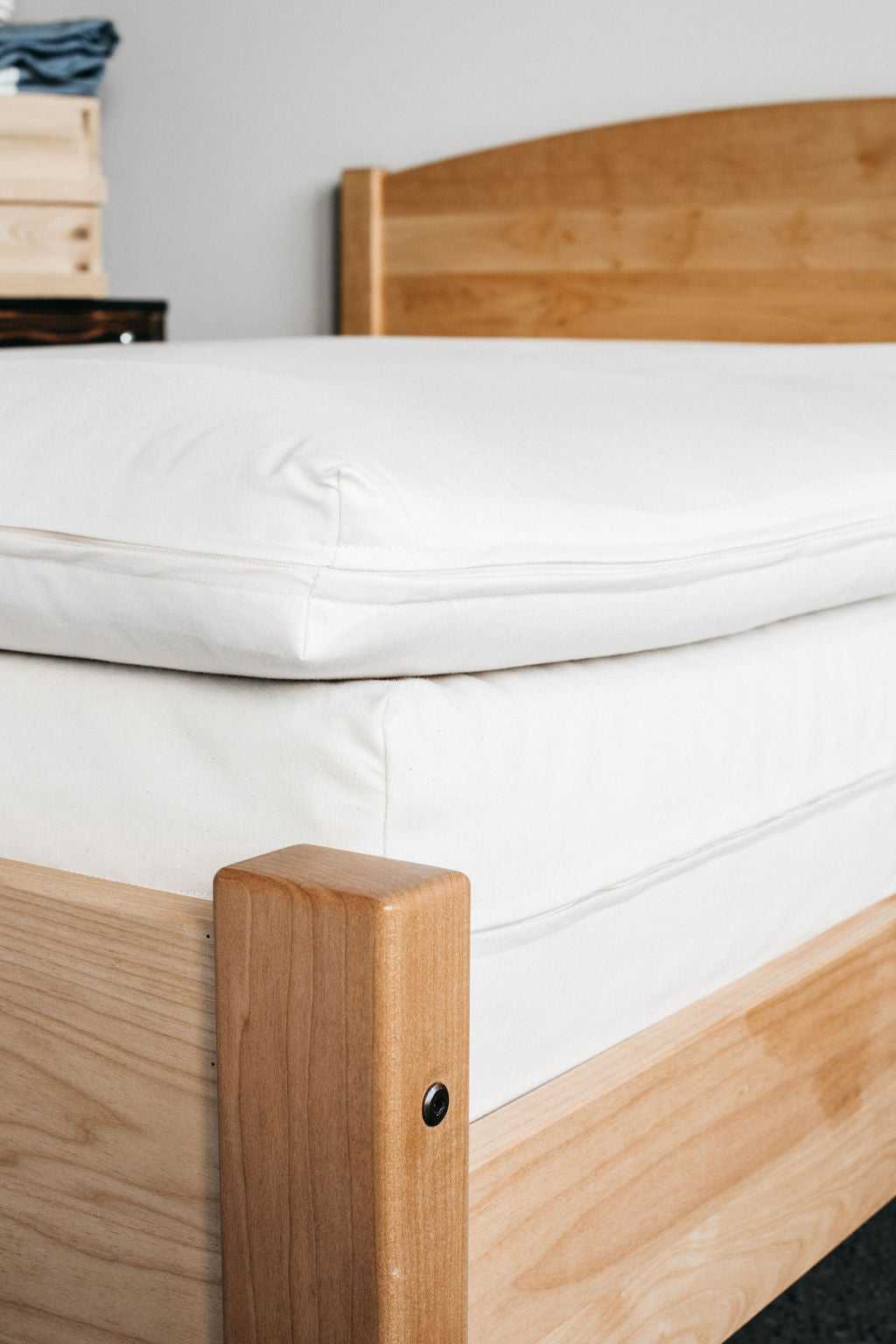
In a luxury topper, the filling is only one part of the design. Its enclosure, stitching, border and overall profile affect how it lies on the bed and how it wears. A well-made cover helps contain the filling; quilting or other internal methods may help limit shifting. Edge treatments can influence the silhouette and the way the topper sits beneath bedding. These details are not merely decorative. They help describe the object you will live with every night.
Ask whether the topper is a single filling layer or a blend. If there are multiple materials, find out how they are arranged: one may supply a springier core, while another provides a softer surface or helps hold the filling in place. The order and proportion matter. Two toppers that both mention horsehair could feel quite different if their construction differs substantially.
Thickness also deserves attention. Height can influence the amount of cushioning and the overall profile of the bed, but a taller topper is not automatically more comfortable or supportive. A substantial layer may alter the way fitted sheets sit, affect the height of the sleeping surface and change how the sleeper feels the underlying mattress. Confirm that the sheets have enough depth and that the topper will stay in place within the existing bedding arrangement.
Look for specific dimensions rather than relying on a general category such as “plush” or “luxury.” If the manufacturer provides the topper’s finished height, filling composition, cover fabric, fastening method and care instructions, those facts give a more useful picture than a mood-led description alone.
How horsehair compares with wool and latex
Wool, latex and horsehair serve different roles in bedding, though a single topper may combine materials. Wool is commonly used as a breathable, insulating fiber, and it can bring a soft, yielding quality to a surface. Its natural crimp and the way it is layered or quilted influence loft and feel. Wool-filled toppers may be a considered choice for sleepers who want a fibrous, cushioned layer, but their thickness and density vary widely.
Latex behaves differently. A latex core is generally more elastic and continuous than loose or layered fibers, offering a buoyant form of cushioning. Its precise feel depends on the latex formulation, firmness, thickness and whether it is Dunlop or Talalay. In a blended design, wool may surround or cover latex, joining a fiber surface with a more defined resilient core. That combination is not equivalent to a horsehair fill, even if both are described as responsive.
Horsehair, where accurately specified, offers a connection to older upholstery and mattress traditions. Its appeal may be its particular spring, its place in a layered construction, or the craftsmanship associated with preparing and containing it. This heritage can be compelling, but it should be evaluated alongside tangible details. Ask how the fill is cleaned and prepared, what other materials are present, and what care the finished topper requires.
There is no universal winner. A person who enjoys a lively, structured surface may prefer one construction; someone who wants a plush, woolly cushion or the more continuous spring of latex may prefer another. The relevant question is not which material sounds most luxurious, but which finished layer works with the mattress and the way you sleep.
Questions to ask before choosing a horsehair mattress topper
Luxury bedding descriptions often use evocative language. A little curiosity helps translate that language into useful information. Before buying, consider asking the maker or retailer:
- What does “horsehair” or “horsetail” mean in this specific product? Confirm the source and type of fiber rather than assuming the terms are interchangeable.
- Is the filling pure or blended? Request the listed materials and, where available, their proportions.
- How is the fill arranged? Find out whether it is loose, layered, stitched into place or paired with wool, latex, cotton or other materials.
- What is the finished height? Check the full topper dimensions and consider the effect on fitted sheets and bed height.
- How should it feel? Ask for a clear description of its surface character, while remembering that firmness and comfort are subjective.
- How should it be maintained? Confirm whether it can be aired, rotated, spot-cleaned or professionally cleaned, and follow the maker’s instructions.
- What is the return or trial policy? Check the time frame, condition requirements, shipping costs and any exclusions before purchase.
- What sourcing information is available? If animal welfare, origin or processing matters to you, request specific documentation rather than relying on a broad adjective.
These questions are especially useful when product pages rely on a single headline material. A well-documented topper should make its composition and care legible enough for a shopper to assess whether it suits their priorities.
Care, longevity and everyday practicality
Maintenance is part of the luxury calculation. Some toppers are designed for regular airing and rotation; others have more specific cleaning requirements. A filling that cannot be machine-washed may call for extra protection from spills and perspiration. Check the instructions before purchase, not after the first accident, and never assume that a natural fiber can be laundered simply because it feels familiar.
A breathable mattress protector can help shield the topper and mattress from everyday soil, provided it does not undermine the surface feel you want. Use a protector compatible with the topper’s dimensions and care guidance. If the product is meant to be rotated, note the recommended schedule; this may help distribute wear. Avoid exposing materials to direct sunlight or heat unless the manufacturer explicitly recommends it.
Durability is shaped by more than fiber identity. It depends on the quality of the materials, the construction, the weight placed on the bed, the frequency of use and the way the topper is maintained. A resilient filling does not make a product immune to settling or wear. Ask what the maker says about expected performance and warranty coverage, and read the terms rather than treating a warranty as an unlimited promise.
It is also worth asking how the topper is intended to be used. Some are designed to sit directly on the mattress; others need a protector, fitted sheet or particular arrangement to remain secure. A topper that shifts during the night can compromise even a beautiful bed, so corner straps, dimensions and compatibility with the mattress matter in daily life.
A note on natural, organic and performance claims
Terms such as “natural,” “organic,” “hypoallergenic” and “chemical-free” can carry broad implications. They should be read carefully and in context. A fiber’s origin does not, by itself, describe every step of its processing or the composition of the complete topper. If a certification is named, check which material or component it covers and what standard is being referenced.
Likewise, no filling can guarantee a particular health outcome or eliminate every allergen. People with allergies or sensitivities should review the full materials list, consider protective covers and consult appropriate professionals when necessary. The most responsible product description distinguishes between verifiable construction details and general aspirations about comfort or wellbeing.
Animal-derived materials also raise questions that individual shoppers may weigh differently. If sourcing, traceability or animal welfare is important to you, seek clear answers from the manufacturer. A heritage material can be appreciated while still being examined with care and contemporary standards of transparency.
Who might be drawn to horsehair fill?
A horsehair-filled topper may appeal to someone interested in traditional mattress construction, natural fibers and a surface with a more resilient character. It may also attract a shopper who values the craft history of bedding and wants to understand how a particular filling contributes to the finished object. In the right design, the material can be part of a thoughtful system rather than a novelty added for its name.
It may be less appealing to someone who prefers the softest possible, deeply sinking surface, or who wants a topper that can be thrown into a washing machine. The answer depends on the particular model: a blend can soften the feel, and care requirements vary. Do not infer the experience from a generic description of horsehair alone.
Sleep position, body weight, preferred room temperature and the mattress’s current condition all influence the decision. If your bed is already comfortable but you want a small refinement, a thinner layer may be enough. If you want a dramatic change in softness, a more substantial design may be worth considering—but only after checking how it works with the mattress below.
A considered final layer
Horsehair and horsetail fibers occupy a distinctive place in the language of luxury bedding: practical materials with a history, capable of contributing structure and a particular kind of resilience. Their presence can make a topper feel considered and traditional, but the final experience is created by the entire construction, not a single ingredient.
For a confident choice, compare the filling name with the material breakdown, finished height, stitching, cover, care instructions and trial policy. Consider what you want to change about the mattress you already own, and be precise about the difference between surface comfort and underlying support. Then let the tactile question lead: do you want a softer landing, a buoyant response, a breathable fiber layer or a blend of these qualities?
The best luxury mattress topper is not necessarily the one with the most storied filling or the most elaborate description. It is the one whose materials, construction and maintenance make sense for the bed—and whose feel invites you back to it, night after night.